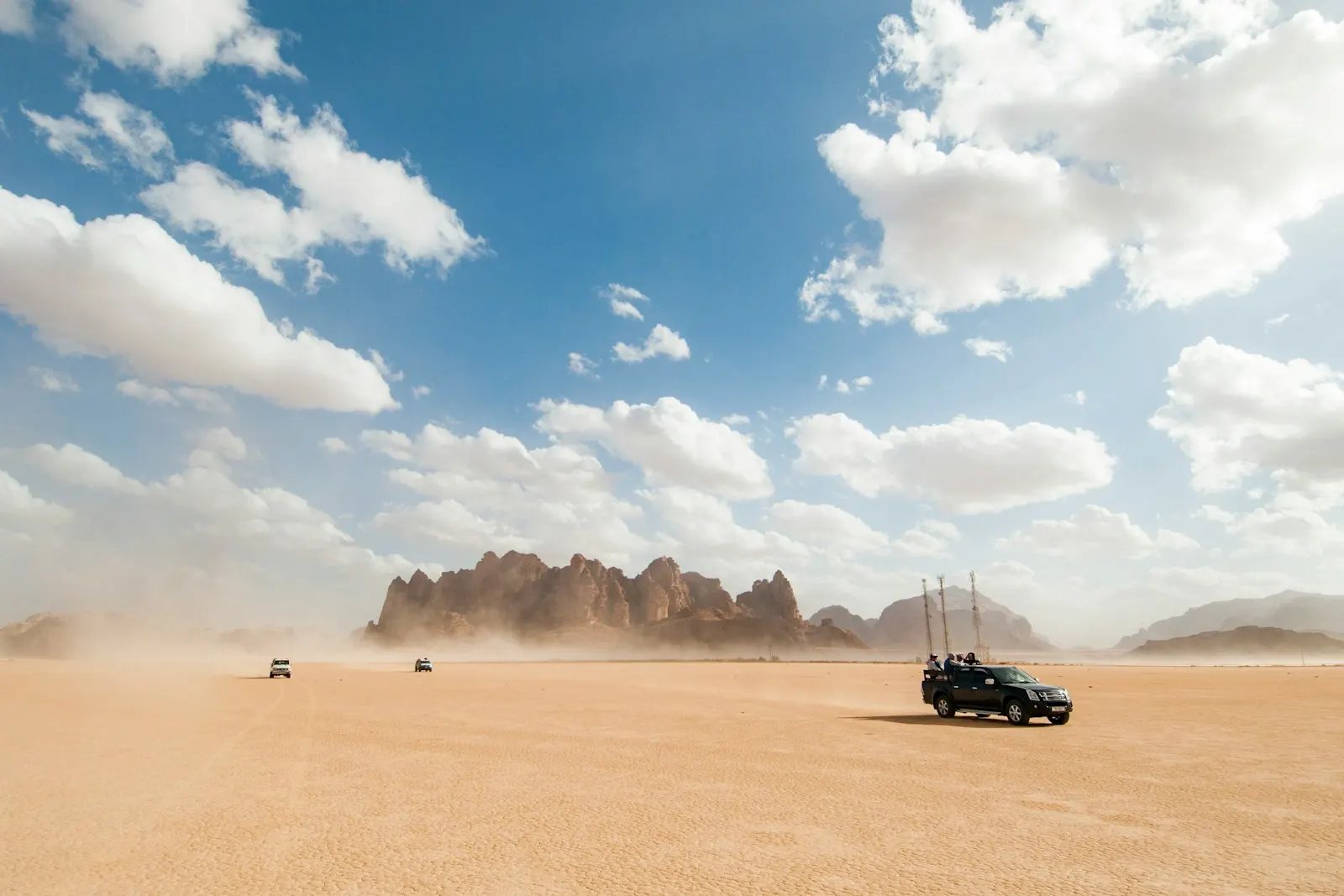
Dropping tire pressure increases the contact patch where the tire meets the ground, and on sand, rock, mud, and snow that larger footprint produces traction no amount of throttle control can replace. Going from a highway 35 PSI down to 15 to 20 PSI can expand the contact patch by 30 to 50 percent. The two tools that make this fast and repeatable are an ARB E-Z Tire Deflator Valve to hit a target pressure on each tire without guessing, and a compressor like the VIAIR 400P Portable Air Compressor or ARB CKMTA12 Twin Motor Air Compressor to get back to highway pressure before you touch pavement again.
Quick answer
Air down roughly 25 percent for maintained dirt roads, 30 to 35 percent for rock and difficult trails, and up to 50 percent for soft sand. Run 18 to 22 PSI on sand, 22 to 25 PSI on rocks, and 25 to 28 PSI on forest roads. Never go below 15 PSI without beadlocks, then air back up before pavement.
This guide contains affiliate links. TrailBaseGear may earn a commission at no cost to you.
Why airing down works
A tire at highway pressure presents a small, rounded contact patch designed for low rolling resistance on pavement. Lower the pressure and the tire flattens out, lengthening and widening the footprint that touches the ground. That larger footprint spreads the vehicle weight over more surface area, which is exactly what you want on soft or loose terrain where a small high-pressure patch simply digs in and sinks.
The numbers are significant: dropping from 35 PSI to 15 to 20 PSI increases the contact patch by roughly 30 to 50 percent. On sand it is the difference between floating across the surface and burying the vehicle to the axles. On rock, a softer tire wraps around edges for grip and resists punctures. The ride also smooths out noticeably because the tire absorbs impacts the suspension would otherwise transmit to the cabin.
Target PSI by terrain
Think in two ways: a percentage drop from your normal pressure, or an absolute target. As a percentage, drop about 25 percent for rough dirt roads and moderate trails, 30 to 35 percent for slick rock and technical trails, and up to 50 percent for very soft sand. As absolute starting targets for a typical SUV or light truck, run 18 to 22 PSI for sand and loose ground, 22 to 25 PSI for rocky technical terrain, and 25 to 28 PSI for maintained forest and dirt roads.
These are starting points, not rules. A wider, heavier vehicle generally needs to go lower than a light one to achieve the same footprint expansion on the same tires. The honest answer is that the right pressure is the one that visibly bulges the sidewall and floats the vehicle on the surface you are driving, so start conservative at around 20 PSI and adjust down based on what you see.
Whatever your target, set it once on the ARB E-Z Tire Deflator Valve and let it deflate each tire to that exact pressure automatically. That consistency matters: uneven pressures across four tires affect handling and traction more than most drivers expect.
Field reference / File TBG-013 air compressors tires

ARB E-Z Tire Deflator Valve
A calibrated Schrader valve tool that deflates four tires to a preset PSI automatically without guessing or checking repeatedly.
The bead-break safety limit
Standard wheels rely on tire pressure to keep the bead seated against the rim. Drop too low and a hard cornering load can break the bead, separating the tire from the rim for an instant flat that strands you on the trail. On standard tubeless tires without beadlock wheels, treat 15 PSI as a firm floor and 12 PSI as the absolute debead threshold you do not cross.
Beadlock wheels mechanically clamp the bead to the rim and can run far lower safely, which is why hardcore rock crawlers air down into the single digits. Most overlanders are on standard wheels, so the practical rule is simple: stay at or above 15 PSI unless you have beadlocks, and never drive faster in MPH than your PSI. At 18 PSI, keep speeds under 18 MPH to avoid heat buildup and bead roll.
The air-down and air-up procedure
Airing down takes a few minutes at the trailhead and pays off the moment you hit soft ground. Airing back up is the step too many people skip, and driving aired-down tires at highway speed builds heat, ruins handling, and risks a bead break. Carry your own compressor so you are never dependent on finding a gas station air pump miles from the trail exit.
For air-up, a VIAIR 400P Portable Air Compressor handles tires up to 35 inches and stores in the cargo area, while a permanently mounted ARB CKMTA12 Twin Motor Air Compressor with its 100 percent duty cycle refills four large tires without overheating on a hot afternoon. Either way, do all four tires before you leave the dirt.
Field reference / File TBG-054 air compressors tires

VIAIR 400P Portable Air Compressor
A portable 12V compressor with a 150 PSI maximum working pressure and direct battery clamp connection, designed for tires up to 35 inches.
Field reference / File TBG-051 air compressors tires

ARB CKMTA12 Twin Motor Air Compressor
A twin-cylinder 12V compressor with a 100-percent duty cycle, 6.16 CFM output, and a permanently mounted design built for repeated high-demand use.
What else to carry
Airing down is a traction tool, not a recovery tool. When lower pressure is not enough on deep sand or mud, a pair of MAXTRAX MKII Vehicle Recovery Boards slides under the tires to bridge the soft spot and get you moving again. The two work together: air down first to maximize traction, and reach for the boards only when the terrain still wins.
Build the full air and traction kit by browsing the /best/air-compressors-tires/ category, then add traction boards from /best/recovery-gear/ so you have both the pressure tools and the extraction backup in the same trip.
Field reference / File TBG-010 recovery gear
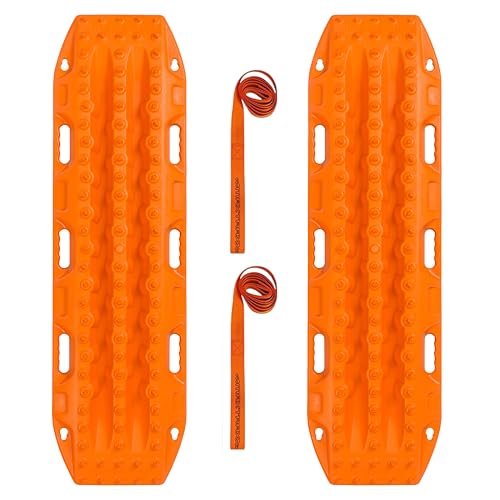
MAXTRAX MKII Vehicle Recovery Boards
The gold-standard traction boards used by professional expedition teams, molded in reinforced nylon with aggressive cleats that bite into sand, mud, and snow.
Field reference / File TBG-013 air compressors tires
ARB E-Z Tire Deflator Valve
A calibrated Schrader valve tool that deflates four tires to a preset PSI automatically without guessing or checking repeatedly.
Field reference / File TBG-054 air compressors tires
VIAIR 400P Portable Air Compressor
A portable 12V compressor with a 150 PSI maximum working pressure and direct battery clamp connection, designed for tires up to 35 inches.
Field reference / File TBG-051 air compressors tires
ARB CKMTA12 Twin Motor Air Compressor
A twin-cylinder 12V compressor with a 100-percent duty cycle, 6.16 CFM output, and a permanently mounted design built for repeated high-demand use.
Field reference / File TBG-010 recovery gear
MAXTRAX MKII Vehicle Recovery Boards
The gold-standard traction boards used by professional expedition teams, molded in reinforced nylon with aggressive cleats that bite into sand, mud, and snow.
FAQ
Frequently asked questions
What PSI should I air down to for overlanding?+
Start at 18 to 22 PSI for sand and soft ground, 22 to 25 PSI for rocks and technical terrain, and 25 to 28 PSI for maintained dirt roads. As a percentage rule, drop about 25 percent for dirt roads, 30 to 35 percent for difficult trails, and up to 50 percent for very soft sand. The exact number depends on your tire size and vehicle weight, so start conservative and adjust based on how the sidewall bulges.
How low is too low when airing down?+
On standard tubeless tires without beadlock wheels, 15 PSI is a safe floor and 12 PSI is the debead threshold you should not cross. Below that, a cornering load can break the bead off the rim and cause an instant flat. Beadlock wheels mechanically clamp the bead and can run much lower safely. When aired down, never drive faster in MPH than your tire PSI to limit heat and bead roll.
Do I have to air back up before driving on the highway?+
Yes. Aired-down tires at highway speed build excessive heat, handle poorly, and risk a bead break. Always return all four tires to highway pressure at the trail exit before driving on pavement. Carrying your own compressor like a VIAIR 400P or an onboard ARB twin eliminates the dependency on finding a gas station air pump, which is often miles from where the trail meets the road.
What is the fastest way to air down four tires?+
A preset deflator tool like the ARB E-Z Deflator. You calibrate it once to your target pressure, attach it to each Schrader valve, and it deflates to that exact PSI and stops automatically. This drops the air-down time for four tires from around 20 minutes of crouching and gauge-checking to just a few minutes, and it guarantees consistent pressure across all four tires.